Disclosure: this page contains our Bitget referral link and code. If you sign up through it we may earn a commission at no extra cost to you. It never changes what we write. How we make money. Not financial advice.
56969Disclosure: we may earn a commission if you sign up through our link. Our code links you to Bitget’s Referral Program the same way any valid code does; it doesn’t change fees or the welcome package.
Key takeaways
- Bitget says it was founded in 2018; BTG Technology Holdings Limited operates it.
- Bitget’s licence page lists nine places, each limited to listed activities.
- Base fees: 0.1% for spot, 0.02% maker / 0.06% taker for futures.
- Proof of reserves and the Protection Fund are Bitget’s own tools, not deposit insurance.
What is the Bitget exchange?
The Bitget exchange is a centralized crypto exchange, meaning a company that holds your coins and matches your orders. Bitget’s About page says it was founded in 2018. Its Terms of Use, last updated November 4, 2026, name BTG Technology Holdings Limited as the company that operates the platform.
You send coins or cash to your Bitget account, trade inside it, then move funds out to your own wallet or bank. While your coins sit on Bitget, Bitget holds them for you.
Bitget’s About page says it serves “over 150 million users”, while its Security Center headline says “Trusted by 125M users”. The About page counts registered users; the Security Center doesn’t say what it counts, so treat both as Bitget’s claims. Bitget’s October 2026 reserves press release carries a Victoria, Seychelles dateline, but we found no Bitget page that states a headquarters address.
Watch: What Is Bitget Exchange? Full 2026 Walkthrough (Code 56969)
Which licences and registrations does Bitget list?
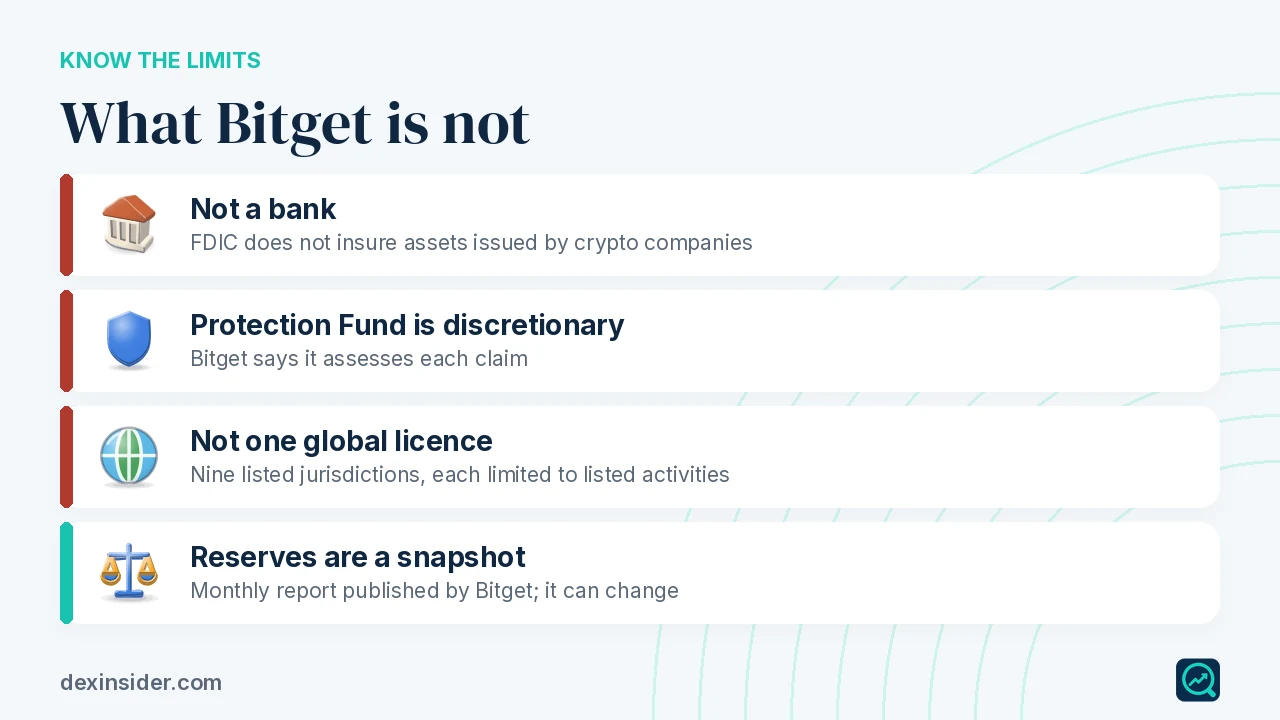
Bitget lists licences, registrations and approvals in nine places on its Regulatory License page. Each one covers only the activities listed, in that one place. None of them is a global licence. A registration in one country says nothing about the rules where you live.
| Jurisdiction | What Bitget lists | Regulator Bitget names |
|---|---|---|
| Australia | Digital currency exchange provider registration. | AUSTRAC |
| UK | Platform partnering with an FCA-authorised person (Section 21 approval). | FCA |
| Switzerland | Member of an anti-money-laundering self-regulatory body. | FINMA-recognised SRO |
| South Africa | Crypto Asset Service Provider and OTC derivatives licences. | FSCA |
| Argentina | Virtual asset service provider. | CNV |
| Mexico | Vulnerable Activity registration. | SAT |
| El Salvador | Bitcoin Service Provider and Digital Asset Service Provider. | BCR and CNAD |
| Mauritius | Investment Dealer licence. | FSC |
| Georgia | Exchange, wallet and custody provider (Tbilisi Free Zone). | Tbilisi Free Industrial Zone |
Australia is the one entry we could check with a regulator. In a July 2025 investor alert, ASIC, Australia’s financial markets regulator, said Bitget is registered with AUSTRAC, the country’s anti-money-laundering agency. But ASIC also said Bitget does not hold an Australian Financial Services licence. The regulator called Bitget’s crypto futures products unlicensed in Australia. The alert also cites warnings from other regulators, including France and Germany. When I checked ESMA’s interim MiCA register of crypto-asset service providers on November 25, 2026, I found no entry naming Bitget in the file dated November 20, 2026. ESMA says it updates the register weekly. MiCA is the EU’s crypto-asset law, and ESMA is the EU’s securities markets authority. The UK row also sits beside Bitget’s May 2024 notice restricting new UK users, which we cover below.
What products does the Bitget exchange offer?
The Bitget exchange offers spot trading, futures, copy trading, trading bots, Earn products, a P2P marketplace and Launchpool. The others add borrowed money, bots or lock-ups, and each one adds its own risk.
Spot and USDT
Spot trading is buying or selling a coin outright, so you own the coin itself. USDT is a stablecoin, a token designed to track the US dollar. For example, buying 20 USDT of Bitcoin on spot gives you that Bitcoin, which can still fall in price.
Futures
Futures are contracts that bet on a coin’s price without owning it. Margin is the money you post to back a futures position. Leverage is borrowed exposure that makes a position larger than your margin. Liquidation is when Bitget closes your position because your margin falls below the required level. A funding fee is a payment that long and short traders exchange at set times on perpetual futures.
Copy trading and bots
Copy trading is a feature that copies another trader’s positions into your account for you. Bitget calls those traders “elite traders”. Its fee FAQ says followers pay those traders a profit share, set by each trader. Bots are automated strategies that place orders for you. For example, Bitget’s Spot Position Grid bot places buy and sell orders within a preset price range.
Earn, P2P and more
Earn is Bitget’s set of products that pay a yield on deposited coins. When I checked Bitget’s Earn page on November 25, 2026, I found rates shown as ranges that differ by coin, with flexible and fixed terms. Earn APRs are variable and carry no promise of a set return, so we give no figures.
P2P is a marketplace where users trade crypto for local currency. Bitget says the offers come from users, and the seller’s crypto is held in escrow. BGB is Bitget’s own token. Launchpool is a feature where you lock BGB to earn new tokens, Bitget says. Bitget Wallet is a separate non-custodial wallet: only you hold its private key.
Bitget fees: base rates for spot and futures
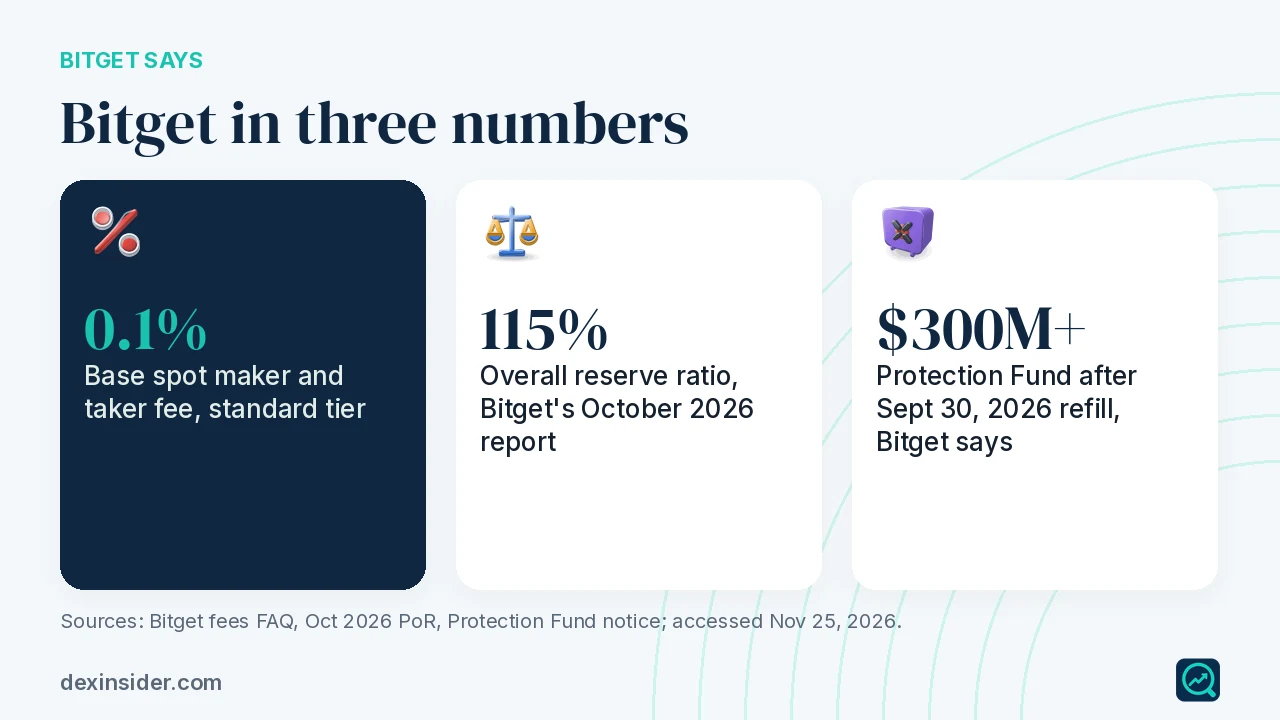
Bitget’s Trading Fees FAQ, dated August 20, 2026, gives base rates of 0.1% for spot makers and takers. Futures cost 0.02% for makers and 0.06% for takers. Bitget says VIP levels, BGB holdings and promotions can lower these standard-tier rates. So a 100 USDT spot buy at the base rate costs 0.1 USDT in fees. Check Bitget’s fee schedule first.
A maker is a trader whose order waits in the order book, such as an unfilled limit order. A taker is a trader whose order fills at once against an existing one. For example, Bitget’s fee guide says one BTCUSDT futures contract closed at 40,000 USDT costs 24 USDT as a taker or 8 USDT as a maker.
Bitget says P2P trades carry no Bitget fee, though your payment provider may charge one.
How does Bitget protect user funds?
Bitget points to three safety signals: monthly proof of reserves, a Protection Fund and tools to lock down your account. Proof of reserves is a published snapshot comparing the crypto an exchange holds with its users’ balances. Bitget’s October 2026 report, its 48th, gave an overall reserve ratio of 115%.
A Merkle tree is a data structure that lets you check your own balance was counted without seeing anyone else’s, and Bitget says its monthly reports use one. A cold wallet is a wallet kept offline, away from the internet; Bitget’s Security Center says it separates cold and hot wallets. The Protection Fund is Bitget’s own reserve for incidents that hit the whole platform. Bitget says it set it up in 2022 at $300M, backed by 5,500 BTC. After a security incident on September 24, 2026, Bitget says it designated the fund to cover the financial impact, with an estimated affected amount of $388M, and user balances “remained accurate and unaffected”. On September 30, 2026, Bitget said the fund had been replenished to $300M+.
On your side, two-factor authentication (2FA) is a second login check, such as a code from Google Authenticator. An anti-phishing code is a personal code of 8 to 32 digits that Bitget shows in its official emails and SMS, except SMS verification codes.
Is Bitget a bank, and are deposits insured?
No. Bitget is a crypto exchange, not a bank, and we found no Bitget page that offers deposit insurance. Its Protection Fund page says Bitget “reserves the right to assess each claim”. So we found no government scheme that would repay your coins if Bitget failed.
The US FDIC’s fact sheet says it “does not insure assets issued by non-bank entities, such as crypto companies”. ASIC’s alert adds that Australians using unlicensed products can’t access protections such as client money rules.
Bitget eligibility: age and countries
Bitget’s Terms require you to be 18 or older and outside a prohibited location. The Terms, last updated November 4, 2026, list 30 countries and regions, plus “such other locations” Bitget designates from time to time. One person may hold only one account.
- Americas: the United States and its territories, Canada, Cuba and Haiti.
- Europe: Austria, Belarus, France, Germany and Russia, plus the Crimea, Luhansk, Donetsk, Kherson and Zaporizhzhia regions of Ukraine.
- Asia: Afghanistan, Hong Kong, Japan, Kazakhstan, Malaysia, North Korea, Singapore and Thailand.
- Middle East: Iran, Iraq, Lebanon, the United Arab Emirates and Yemen.
- Africa: Sudan, South Sudan, Libya, Somalia, the Central African Republic, the Democratic Republic of the Congo and Guinea-Bissau.
India: new sign-ups paused from Feb 6, 2026 for users who pick India or use Indian ID. UK: a May 2024 notice said Bitget would temporarily restrict new UK users. Both notices were still on Bitget’s support site on November 25, 2026, with no later update. The Terms also ban getting around restrictions “by use of any virtual private network”.
Bitget isn’t for you if you need bank-style protection, can’t afford to lose your deposit or live in a listed location. Read our risk disclaimer first. Sofia Marques checks each number; see our editorial policy, about us and contact pages.
How should a beginner start on the Bitget exchange?
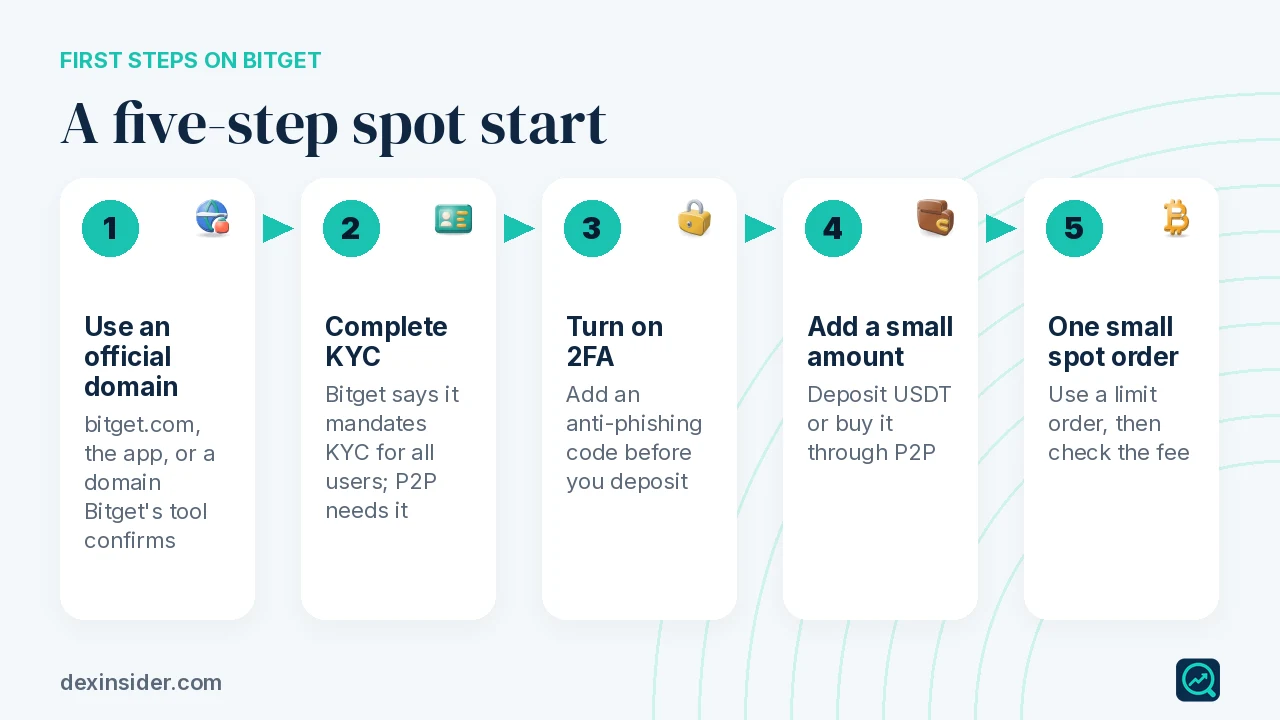
A beginner on the Bitget exchange can start with five small steps: sign up on an official domain, verify ID, secure the account, add a small amount and make one spot buy. KYC is Bitget’s identity check, short for Know Your Customer. Bitget’s registration guide says sign-up is free and needs no documents.
How to make a first small spot trade on Bitget
- Sign up on an official domain. Use bitget.com, the official app, our Bitget affiliate link (it opens a Bitget sign-up page on bitgetapp.com), or a domain Bitget’s Official Verification Tool confirms.
- Complete KYC. Bitget’s licence page says it “mandates KYC for all users”; P2P needs it too.
- Turn on 2FA and an anti-phishing code. Set both before you deposit.
- Add a small amount. Deposit USDT from another wallet, or buy USDT through P2P from a verified user.
- Place one small spot limit order. Buy a coin with USDT, then check the fee shown in your order history.
The “Referral code” field at sign-up is optional, and 56969 works like any valid code, as our Bitget referral code guide explains. Our sign up bonus guide and promo code guide cover the separate new-user rewards. Wait before futures, copy trading and bots until you understand margin and liquidation.
Watch: Bitget Exchange Explained: Beginner Guide 2026 (Code 56969)
FAQ
What is Bitget?
Bitget is a centralized crypto exchange that its About page says was founded in 2018. It offers spot, futures, copy trading, bots, Earn and P2P.
Is the Bitget exchange licensed?
Bitget lists licences or registrations in nine places, including AUSTRAC in Australia. ASIC says Bitget has no Australian Financial Services licence. ESMA’s interim MiCA register showed no Bitget entry on November 25, 2026.
What are Bitget’s trading fees?
Bitget’s Trading Fees FAQ gives base rates of 0.1% for spot makers and takers, and 0.02% maker / 0.06% taker for futures. VIP levels and BGB can lower them.
Is my money insured on Bitget?
No. Bitget is not a bank, and the FDIC says it doesn’t insure assets issued by crypto companies. Bitget’s Protection Fund is its own reserve, and Bitget assesses each claim.
What is the Bitget Protection Fund?
It’s a reserve Bitget says it set up in 2022 at $300M, backed by 5,500 BTC. Bitget says it covered a September 24, 2026 incident and was replenished to $300M+ on September 30, 2026.
Which countries can’t use Bitget?
Bitget’s Terms list 30 prohibited countries and regions, including the United States, Canada, France, Germany and Singapore. Bitget paused new Indian sign-ups from February 6, 2026, and a May 2024 notice said it would restrict new UK users.
Should a beginner use Bitget futures or copy trading?
We suggest starting with spot only. Futures and copied futures positions can be liquidated, so learn margin first.
Does the referral code 56969 change Bitget’s fees or offers?
No. The code goes in the optional “Referral code” field and links your account to a referrer. Bitget’s Referral Program gives invitees who sign up with any valid code its own volume-based rewards; we found no Bitget page that lowers fees for one code, and the welcome package doesn’t depend on a code.

Elliot Varga, Founder & Lead Writer
Elliot Varga spent eight years in derivatives operations at a European broker, handling margin calls and liquidations. He has held crypto since 2018 and used Bitget since 2023. He writes plain-English Bitget guides and reads the fine print first.

Fact-checked by Sofia Marques, Research & Fact-Check Editor. Every number is checked against Bitget’s own pages. Our editorial policy